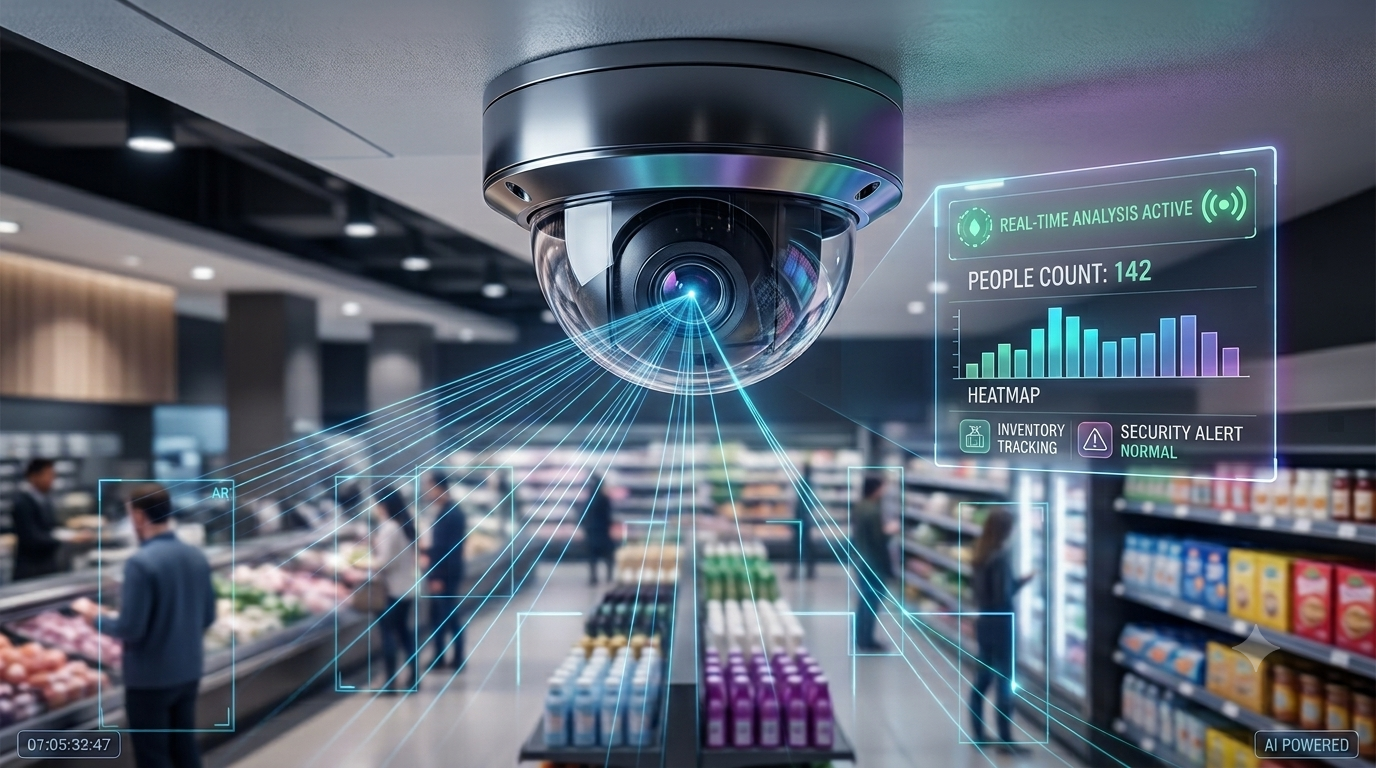
Popular Applications Of Vision AI In Retail
While e-commerce platforms can track every single click, physical retail has historically lagged behind in data collection. Computer Vision bridges this gap by transforming in-store customer movements into measurable data, much like “clickstream behavior” on a website.
Core Application Areas
AI-powered cameras perform several critical functions within the modern retail environment:
Customer Analytics: This includes automated people counting, demographic analysis (predicting age and gender), and the creation of in-store heatmaps to identify high-traffic zones.
Product Engagement: Systems can track which products are picked up, which are put back, and perform automatic shelf-occupancy checks for real-time inventory monitoring.
Operational Efficiency: This covers queue management (detecting checkout density), monitoring staff for uniform policy compliance, and automated cleanliness inspections.
Technical Infrastructure and Privacy
The implementation emphasizes the importance of Edge AI, where data is processed locally rather than in the cloud:
Cost and Speed: Processing at the “edge” enables faster, real-time results and reduces costs by eliminating the need for a constant, high-bandwidth internet connection.
Privacy: Images are analyzed directly on the device and converted into anonymous metadata (using techniques like face blurring) without being sent to the cloud.
Implementation Challenges and Solutions
Digitalizing the offline world is difficult due to the unique layouts of every physical store.
The Data Bottleneck: The costs associated with specialized sensor installation and maintenance can be prohibitively high.
The Solution: End-to-end platforms like Viso Suite reduce hardware dependency by turning existing security cameras (CCTV) into intelligent sensors, allowing for easy system scalability.
Visual AI In Retail: Business Value Summary
Strategy: Analyzes customer traffic and high-density zones.
Business Value: Optimizes store layout and product placement for maximum efficiency.
Operational Excellence: Shelf Tracking
Strategy: Monitors product stock levels in real-time.
Business Value: Prevents “Out-of-Stock” (OOS) crises to avoid loss of sales